


By Sam Li and Lewis Jackson
BEIJING, Aug 14 (Reuters) - China's exports of electric trucks to other Asian countries have spiked, adding to a surge in domestic sales as higher fuel costs as a result of the Iran war accelerate regional electrification.
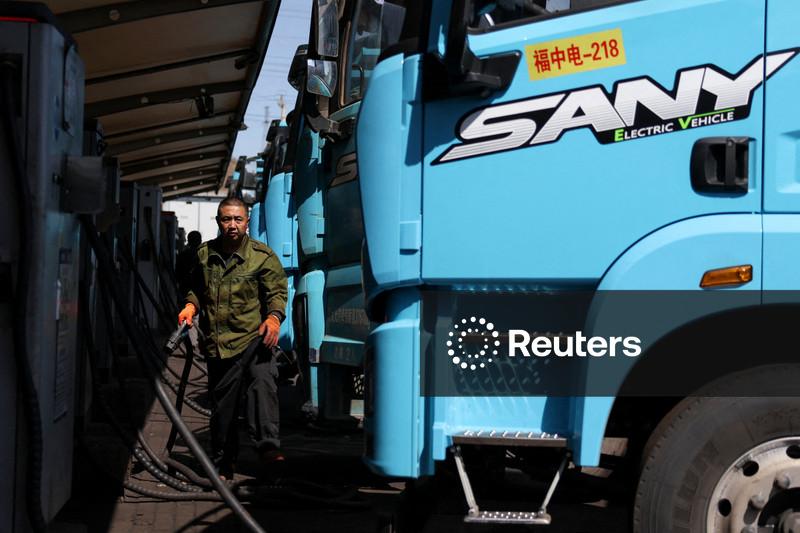
China’s rapid adoption of e-trucks — from lighter vehicles to tractor-trailers — has partially shielded the world's biggest auto market from the impact of the conflict. Now other countries are scrambling to follow.
In the four months after the U.S. and Israel launched the war on February 28, China's exports of heavy e-trucks more than doubled from the same period last year to 16,823 vehicles. Half went to South and Southeast Asia, with shipments to South Asia up more than fivefold and to Southeast Asia nearly tripling.
WAR OPENS THE DOOR TO MARKETS FOR CHINESE E-TRUCKS
South and Southeast Asia are particularly dependent on the Middle East for oil, and Iran's closure of the Strait of Hormuz has triggered some of the biggest jumps in diesel prices, according to GlobalPetrolPrices.com, creating an opening for China, the world's largest e-truck maker.
Diesel prices are up 48% in Sri Lanka since the start of the war and 57% in the Philippines, according to GlobalPetrolPrices.com, while the fuel is 15% higher in China, government data shows.
“The war has opened the door to these new markets,” said Zhaoting Yue, vice president of international marketing at Sany, the world's biggest maker of electric heavy trucks.
Exports remain relatively small, dwarfed by China's exports of cars and bikes, while regional truck fleets number in the millions. But if growth is sustained and follows a similar arc to e-truck adoption in China, it could make a notable dent in diesel consumption and carbon emissions.
E-trucks in China have gone from almost zero in 2021 to 30% of truck sales last year, with 140,000 e-trucks sold in the first half of this year. Diesel use in China began falling last year.
Sany previously focused on Europe but is pivoting to Southeast Asia and developing cheaper models, Yue told Reuters. In June, the company shipped its largest single order — 880 heavy trucks — he said, declining to say where because the contract was private.
“Before oil prices rose, buyers in these countries might have needed 28 months to recoup their investment in an electric heavy truck," Yue said. "Now, it takes only 18 months.”
Sany expects the war to sustain rapid growth for at least the next year, particularly in Asia, Africa and Latin America, he added.
FUEL-PRICE SURGE WILL 'FOCUS MINDS'
In the United States and Europe, electric delivery vans are increasingly mainstream, but the rollout of larger e-trucks has been far slower. Tesla, for example, which promised to revolutionise the economics of trucking with its electric Semi almost a decade ago, has dropped its goal of “volume production” of the truck by this year.
By not burning diesel, China's e-truck fleet will save the equivalent of 141 million barrels of oil this year, more than 3% of China's total and equal to all its imports from Kuwait, according to the Centre for Research on Energy and Clean Air.
By comparison, China's e-truck exports in the first half replaced fuel at an annual rate of 1.6 million barrels, the Helsinki-based centre estimates.
Hurdles to e-truck adoption include higher purchase prices for the vehicles and gaps in charging infrastructure.
In Australia, an e-truck costs about A$500,000 ($350,000), twice the diesel equivalent, although that is quickly recouped by fuel savings that even before the war cut operating costs by as much as 70% compared to diesel, said Daniel Bleakley, co-founder of Australian electric trucking firm New Energy Transport.
To boost charging infrastructure, Sany is selling customers systems to generate and store power, as well as charge its trucks, said Yue.
The rapid adoption of Chinese electric passenger cars in many markets will also help expand charging networks and provide a boost to truck adoption, said CREA co-founder Lauri Myllyvirta.
"High fuel prices are going to focus minds and get businesses to move fast," he said.
($1 = 1.4172 Australian dollars)
(Reporting by Sam Li and Lewis Jackson in Beijing; Editing by William Mallard)
Did you find this insightful?
Bad
Just Okay
Amazing