


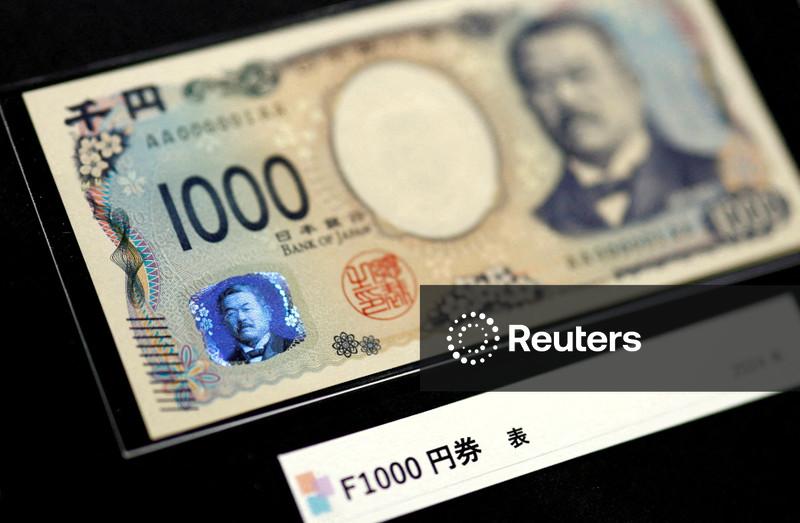
SINGAPORE, Aug 14 (Reuters) - The yen headed for its biggest weekly loss in about a month on Friday as the impact of U.S. and Japanese intervention faded, leaving traders to wager that either rate hikes or another round of official buying would be needed to stem the decline.
The currency has surrendered roughly half the gains sparked by intervention in late July and early August, falling about 0.9% this week to 159.29 per dollar. It was trading near 164 per dollar before July's intervention and traders see the 160 level as a potential trigger for fresh official action.
The yen's retreat mirrors a similar selloff in May, when it was also backsliding after a round of official buying.
The Japanese currency rose slightly in Friday trade after Reuters reported the Bank of Japan is set to raise rates as soon as September and is considering more aggressive hikes to follow, citing three people familiar with policymakers' thinking.
It has been falling, however, for years, and is not far from four-decade lows, thanks to a combination of perennially low interest rates and newer confidence concerns around government spending.
The broader currency market has been fairly steady this week, with support for the dollar from higher oil prices and Middle East tension offset by benign U.S. jobs and inflation reports that reduced expectations for U.S. interest rate hikes.
Thursday figures showing unchanged U.S. producer prices in July further supported dialing back bets on a September hike, now seen as a roughly 35% chance.
The euro edged 0.1% lower to $1.1541 this week while sterling was flat at $1.3498. A surprisingly low inflation expectations reading knocked the New Zealand dollar on Thursday, but it bounced back as the swap market stuck with an 85% chance of a rate hike in September.
The Australian dollar hovered at $0.7065. [AUD/]
THE ONUS IS ON BOJ
Since exiting a massive, decade-long stimulus in 2024, the BOJ has raised interest rates at a pace of roughly twice a year, a tempo it is considering picking up, according to sources familiar with the bank's thinking, Reuters reported on Friday.
Japan may also conduct more joint yen intervention "at any time", Tokyo's former top currency diplomat Mitsuhiro Furusawa told Reuters in an interview.
Markets have already bet on the Bank of Japan raising rates further and sooner than previously expected after U.S. Treasury Secretary Scott Bessent said Japan should reinforce intervention with policies and fundamentals that underpin the yen.
"It's not much of a surprise that the yen has retraced," said OCBC strategist Sim Moh Siong.
"Because for the intervention to change the yen trend, we need to see a more hawkish BOJ stance, which the market is trying to price in, but at the same time, we need validation," he said. "The onus is on BOJ to step up."
Markets currently see a 76% chance of a BOJ hike in September, according to Tokyo Tanshi data, a dramatic increase compared with 24% on July 30, but one which also opens the door to yen falls if investors are disappointed.
China's yuan stood near Thursday's 3-1/2-year high of 6.74 per dollar. [CNY/]
South Korea's won, which was also supported by official intervention as authorities sold dollars in concert with Japan last month, has held steadier than the yen though it was set to notch a modest loss of 0.6% against the dollar this week.
"Interventions, to me, even if they're coordinated, even if they are quite powerful, are at best temporary, and at worst an invitation for the market to challenge them," said Omar Slim, co-head of Asia public fixed income at MetLife Investment Management.
(Reporting by Ankur Banerjee in Singapore and Reuters' Toyko markets team; Writing by Tom Westbrook; Editing by Shri Navaratnam and Jacqueline Wong)
Did you find this insightful?
Bad
Just Okay
Amazing